Classical Philosophy Reading Group (Fall 2026/27)
What is the role of intellectual exchange and debate in a free society?
In the final decades of the Roman Republic, political crisis and intellectual life were deeply entangled. Senators, generals, jurists, philosophers, and orators debated the future of Rome in institutions (like popular assemblies, courts, and armies) but also through books, letters, philosophical treatises, histories, speeches, and other forms of intellectual exchange.
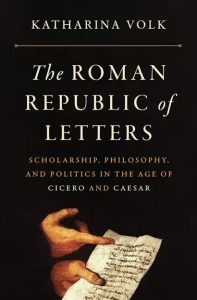
This reading group will explore the intellectual culture of the Late Roman Republic through Katharina Volk’s The Roman Republic of Letters: Scholarship, Philosophy, and Politics in the Age of Cicero and Caesar. Volk’s book examines figures like Cicero, Caesar, Varro, Cato, Brutus, Cassius, and Nigidius Figulus as “senator-scholars,” political actors whose intellectual work was inseparable from their participation in the political world of the Roman Republic.
Our central questions will be: what relationship, if any, exists between intellectual debate and political action? Do ideas shape political choices, or do they merely give political actors a language with which to justify choices already made? How can we tell? Participants are invited to explore how late Republican Romans used philosophy, rhetoric, grammar, antiquarianism (call-backs to earlier periods of history), religion, and memory to make sense of upheaval, civic responsibility, personal ambition amongst social elites, and the felt sense of decay and imminent collapse in Rome’s institutions.
The group will meet periodically on Wednesday evenings at 7:30 p.m. in Lubar Commons, Room 7200, at the Law School. Generally, participants will be expected to commit to attending at least 4 of the 5 planned meetings. Tentative meeting dates are:
- Wed, Sept. 9, 2026
- Wed, Sept. 23, 2026
- Wed, Oct. 21, 2026
- Wed, Nov. 18, 2026
- Wed, Dec. 2, 2026
We welcome undergraduate and graduate students from any discipline who are curious about the intersection of classics, history, philosophy, literature, political theory, and law. No prior knowledge of Latin is required, although a background or interest in the ancient world, political thought, intellectual history, or reading ancient texts will enrich the conversation.
Participants should be eager to contribute to an interdisciplinary dialogue about how ideas circulate in moments of political contestation, and what role intellectual life can play in civic action.
If you have questions, feel free to contact Sig at sbedi@wisc.edu.
Sorry. This form is no longer available.